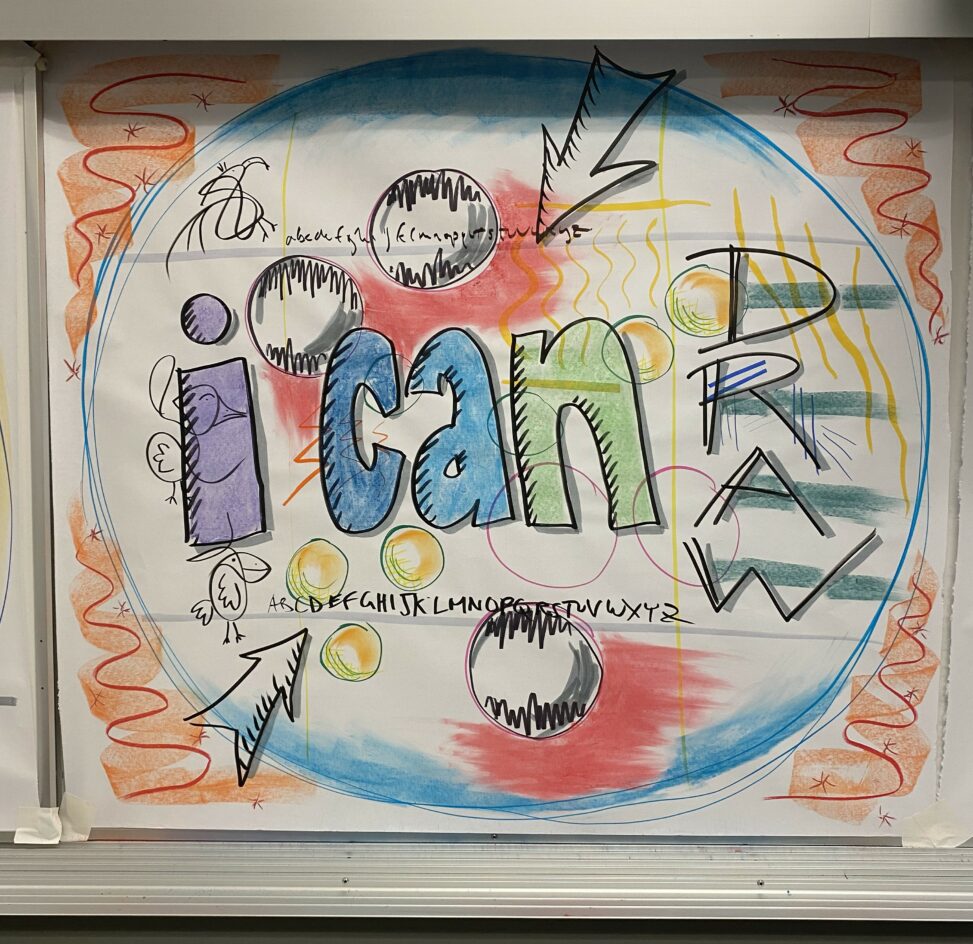
On Wednesday November 29th I had the privilege of attending a day-long Graphic Recording workshop at NIC facilitated by Tracy Roberts from BC Campus. I had met Tracy before when she facilitated the Liberating Structures workshop at NIC pre-COVID, and then again at Studio23, so I was excited to see her again and learn from her. Tracy brings so much fun, humour, enthusiasm, and expertise to her work, she is just one of those people who is a complete joy to be around!
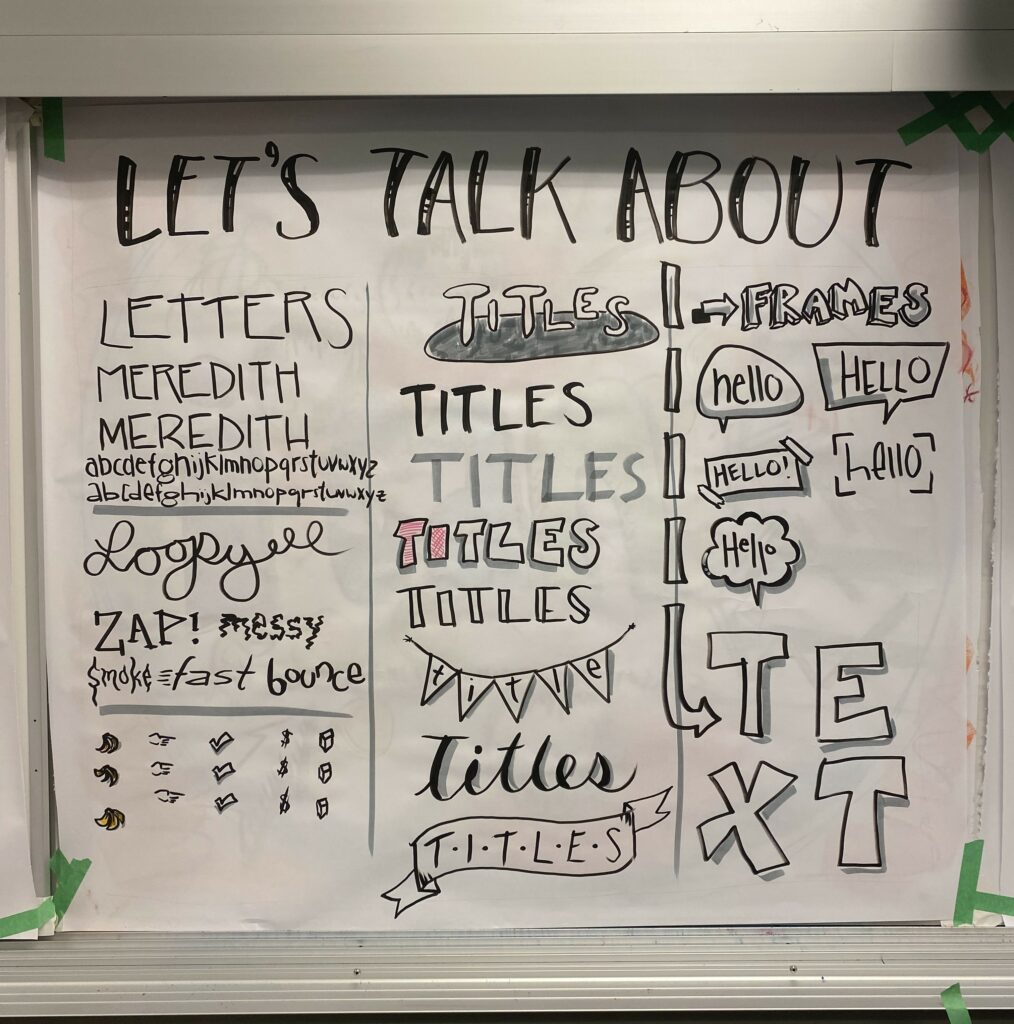
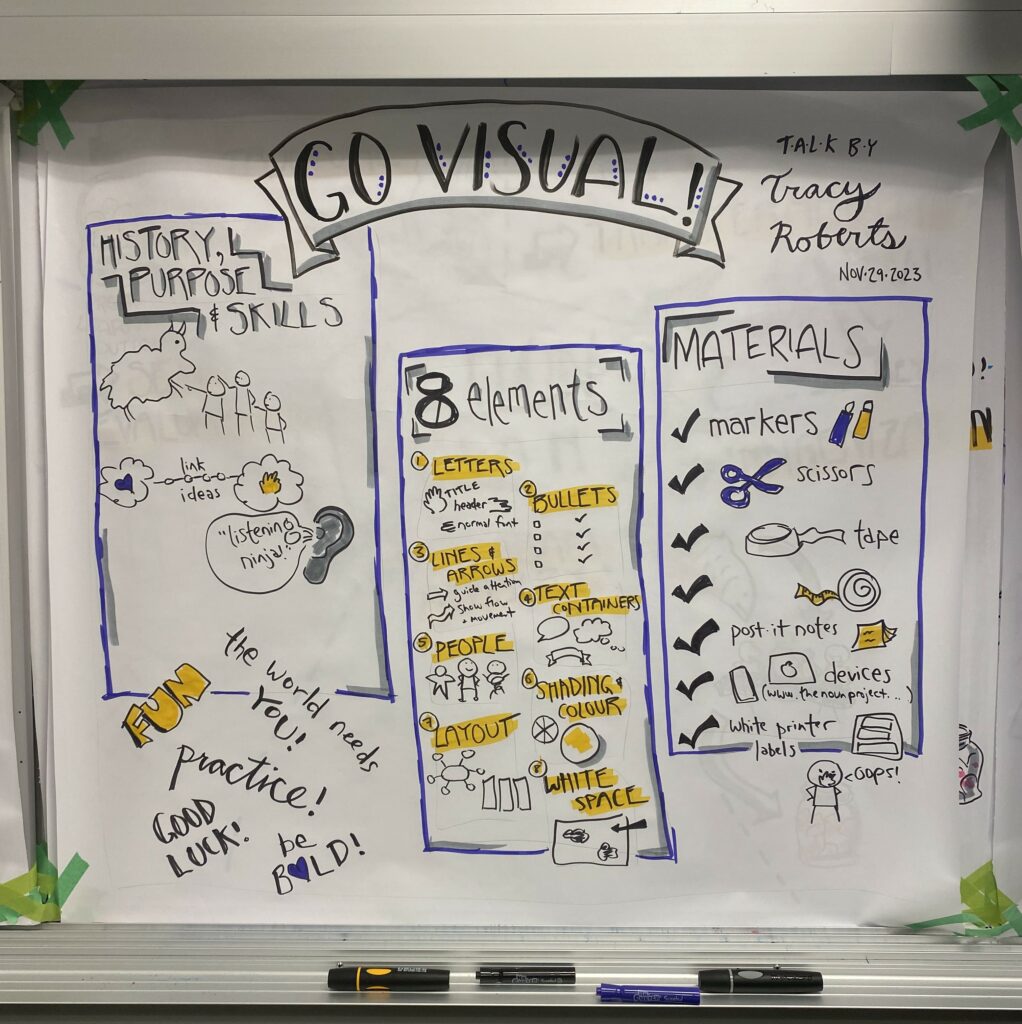
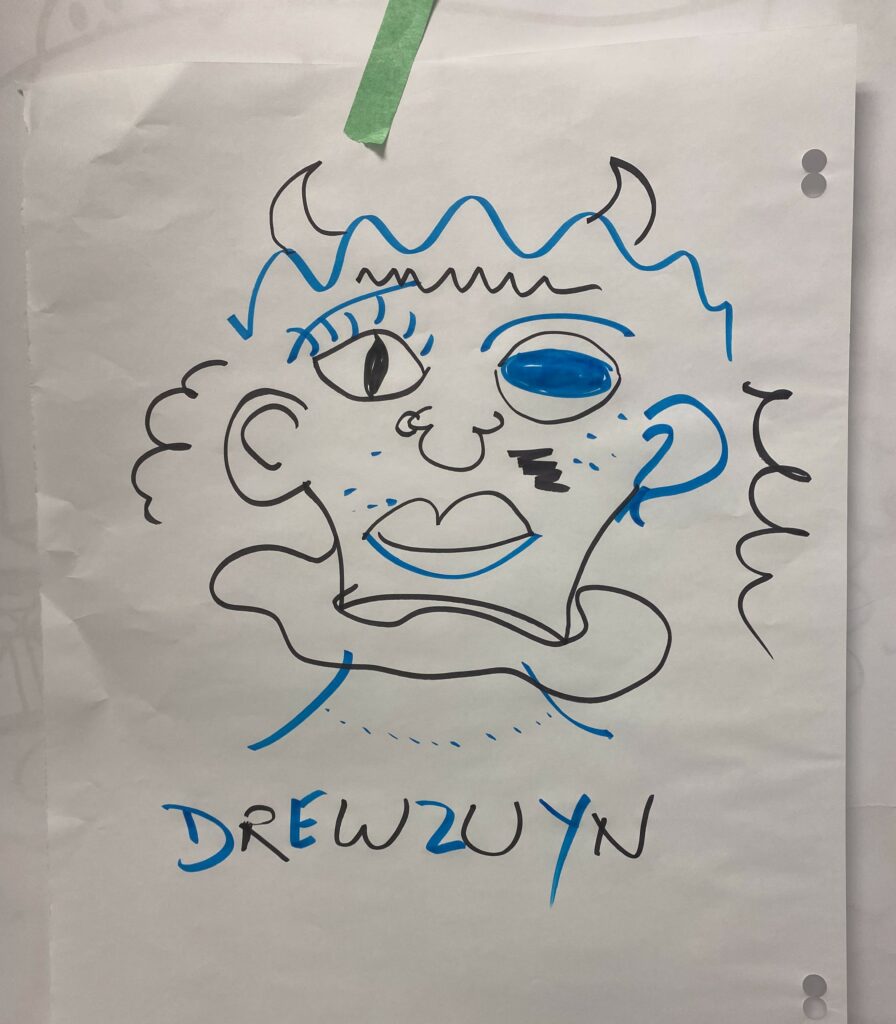
We spent the morning working on big sheets of paper up on the wall, learning how to draw text, frames, people, and developing our “visual vocabulary”. In the afternoon Tracy did a slide show that included some examples of other graphic recorders/facilitators, we did a hilarious face-drawing activity in pairs, and we worked on our own individual graphic project. Finally at the end of the day we had an “exam” where Tracy pretended to give a talk called “Go Visual” and we did our best to live-capture what she had to say.
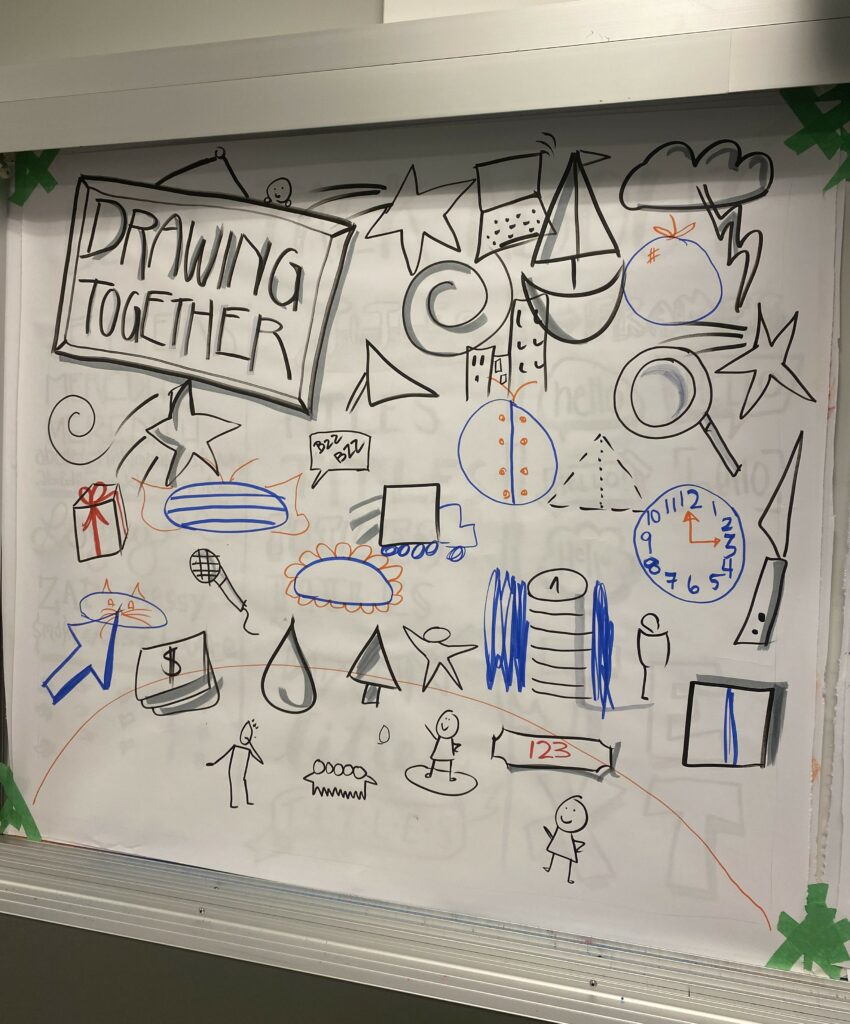
The workshop was a day of learning, practicing, having fun, and connecting with my colleagues both in the Centre for Teaching and Learning Innovation and Health and Human Services. It was so great to do such a participatory workshop where we were together in person, standing and drawing for most of the day, rather than just listening, sitting, or looking at each other on screens. Reflecting back on that day I have been thinking about Graphic Recording and its implementation at NIC for Teaching and Learning within the larger umbrella of visual and arts-based practices. I’m asking myself questions like, as an instructor, how can I bring more visual and arts-based learning practices into my classroom? As a Faculty Developer, how can I teach faculty members to use arts-based practices and help make them feel comfortable? How can I bring arts-based practices into my own workshops and support of faculty? And why does it matter?
This “why does it matter?” question is an important one. One reason that Liesel Knaack (Director of CTLI) talked to us about is the meta-cognitive aspect of dual coding. According to Liesel “Dual coding is a researched and proven student learning strategy that occurs when you pair graphics and visuals with words to learn content” (Knaack, 2023). So in this way, doing Graphic Recording anywhere – in a classroom, in a workshop with faculty, during a meeting – can really help the participants remember, learn, and make meaning from the content.
For me another reason it matters is that it lets us communicate with more breadth and detail than we can when we’re confined by the limits of language and words. For example, at Studio23 I attended a session on creating an Arts-Based Positionality Statement facilitated by Gwen Nguyen and Britt Dzioba from BC Campus. When crafting my visual Positionality Statement I found for the first time I was able to express my gender and sexual-orientation identity (ie. mostly cis-feminine, mostly straight) in a way that felt more true and accurate than I ever have before, and in a much deeper way than I am able to with just a few words. Similarly, when working on my individual project in the Graphic Recording workshop I found my drawing about the concept of “Indigenization” captured a lot more authenticity and nuance than anything I would have tried to write. This line of thinking has me considering how we can use visual and arts-based practices for learning and communication that gives participants that feeling of more truth and being closer to the self.
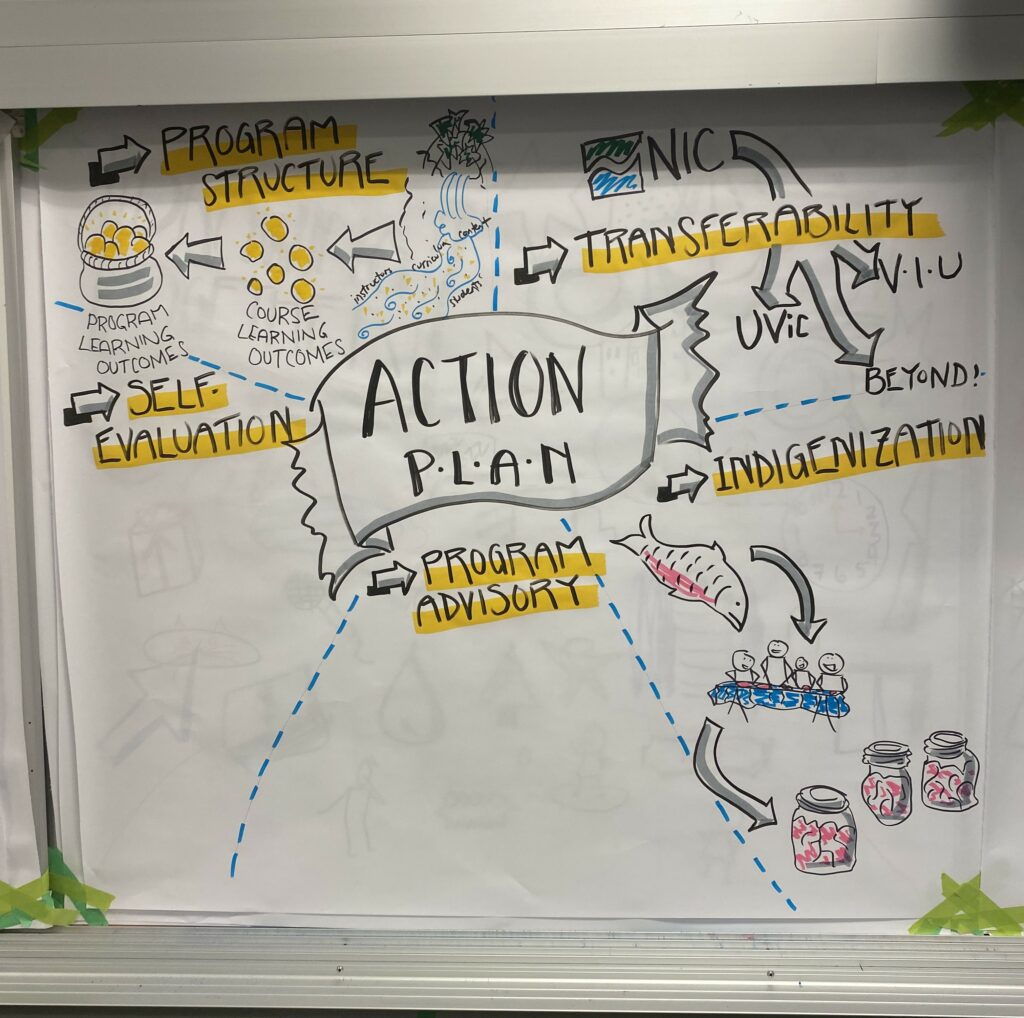
In my teaching practice I started using an assignment with my Family Relationships students this semester called the “Illustrated Family Diagram” where they used basic diagrams from the literature to show their family structure but then enhanced them with colour, symbol and illustration. The results were beautiful and the feedback I got from students was that the assignment helped them uncover new insights about their own families and get closer to the truth of their experiences in their families.
Going forward I am starting to think about and plan how I can use graphic recording, and visual and arts-based practices more broadly, in my work with as a Faculty Developer at the Centre for Teaching and Learning Innovation. One area is to create large visual diagrams to accompany some of the regular activities and workshops that we do regularly and repeatedly for Program Review and Quality Enhancement. If participants can see the processes they are being asked to participate in displayed in a visual form it will help with both the dual-coding learning as well as hopefully creating more depth, detail and truthfulness by filling in all the spaces between the words that are shared. Another direction is to integrate arts-based practices into my work with faculty. What would it look like to draw Learning Outcomes? Or visualize assessments that integrate AI? How could that get more parts of our brain looking at the problem and finding solutions? I believe I will set this as a goal and challenge to myself in the development of a workshop on GenAI that I’m just starting to work on.
One thing is certain, and that is I need more practice! I need to work on integrating drawing and doodling into my day to day life. I need to dig out and dust off my “one drawing a day” book and start filling it in, and practice graphic recording of the online meetings and conferences I attend. With practice I can grow my fluency, creativity, and visual vocabulary so that I can begin to draw and integrate visual practices with more ease. I also need to set up my physical spaces so the tools are readily accessible. I always travel with my laptop and mouse, it’s time to add a black marker and white notebook! Finally, I need to re-connect with the small but mighty Graphic Recording community that started forming on that workshop day. I believe that working together we can inspire each other and grow.
References
Knaack, L. (2023). Dual Coding. Learn Anywhere. Retrieved on December 12, 2023 from https://learnanywhere.opened.ca/learning-strategies/dual-coding/
Leave a Reply
You must be logged in to post a comment.